Tinnitus Masking: How Soft Sound Helps
Tinnitus masking uses soft sound to make ringing less noticeable. Learn how it works, which sounds to pick, and how to find a comfortable level tonight.
By Synra Editorial Team · Updated · 5 min read
It is late. The television is off and the dishwasher has finished. Now the ringing is the only thing in the room. Nothing changed except the noise around it.
Tinnitus masking means playing a soft outside sound so the ringing becomes less noticeable. The NIDCD says sound therapy may work by masking the sound, helping you grow used to it, or distracting you. It is simple, it is easy to try, and you can start with a sound you already have.
Tinnitus masker
Sound is made on your device. Nothing to install.
Start quiet. Raise the level until the ringing just starts to blend in (the “mixing point”), not until it disappears. Keep the volume comfortable, especially with headphones.
What is tinnitus masking?
Masking is one way of using sound for tinnitus. Harvard Health describes it as using external noise to change how you notice or react to the ringing. It lists gentle white noise or nature sounds, fans, radios and sound machines.
Think of a candle. In a dark room it is bright. In a sunny room you hardly see it. The candle has not changed. Its surroundings have.
If you want the wider picture, our guide to tinnitus sound therapy covers all three jobs sound can do. This page is about the masking part.
How does masking work?
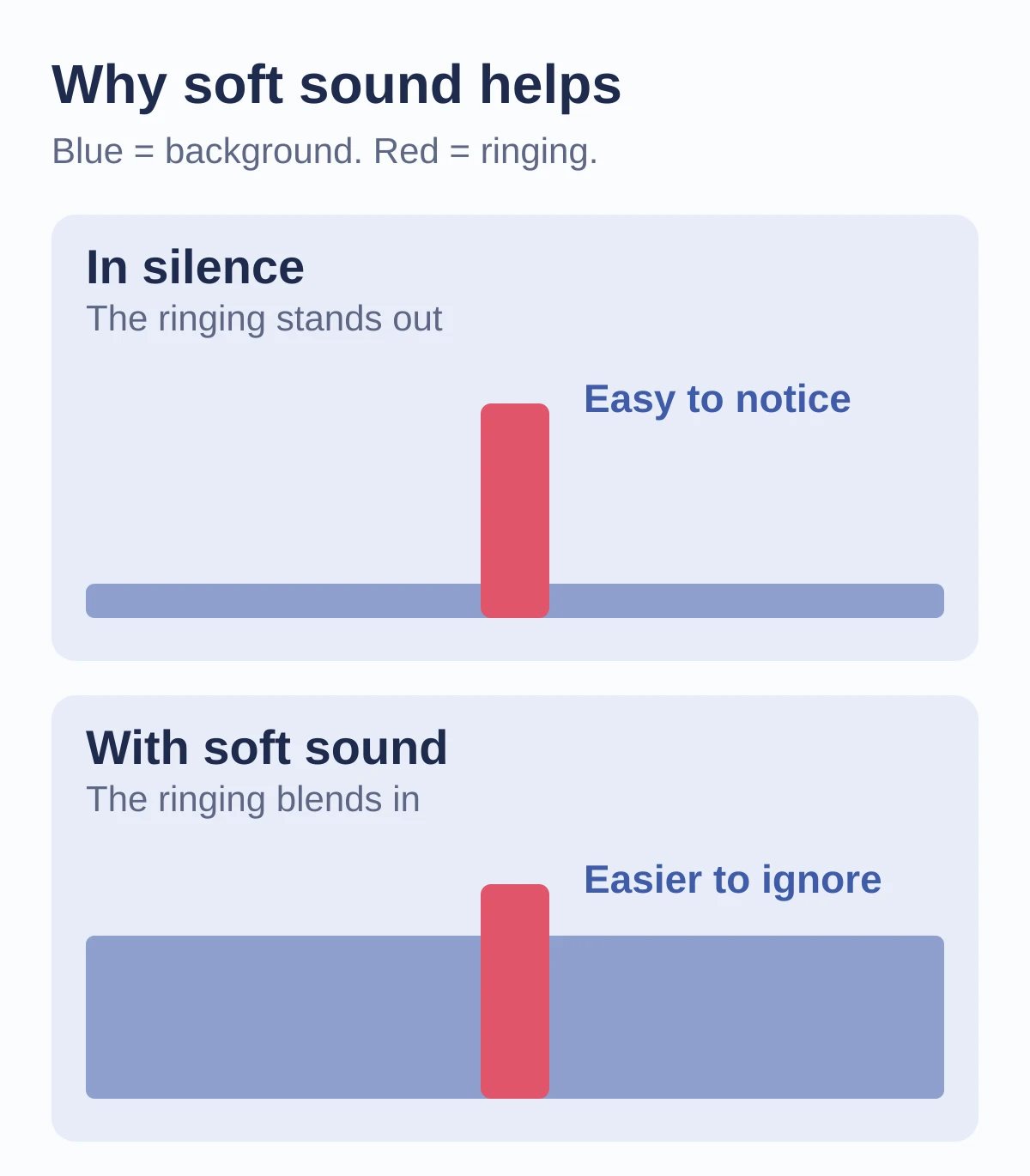
In a quiet room, your brain has little else to listen to. The ringing is the loudest thing there. Soft sound raises the background, so the ringing no longer stands apart.
The NHS puts it plainly: do not have total silence. It says soft music or sounds may distract you from the ringing.
A small lab study shows how reliable the effect can be. Researchers tested 68 people with tinnitus. They found a sound level that covered the ringing in all but one person. They also found that noise matched to the pitch of the ringing, or to the area of hearing loss, covered it at a lower volume than other noise.
That points to a useful idea. The right sound for you may be one that sits close to the sound of your ringing.
Should the sound cover the ringing completely?
It can, but it does not have to. Tinnitus UK says a louder sound that drowns out the tinnitus can give some short-term relief. That is a fine choice for a hard evening.
For everyday use, it suggests a level a little quieter than your tinnitus for most of the time. The ringing blends into the sound instead of vanishing under it. Many people find this easier to keep up for hours.
So you have two settings to play with:
- Cover it: a bit louder, for a bad moment or to settle before sleep.
- Blend it: a little under the ringing, for reading, resting and the rest of the day.
Either way, keep the sound comfortable. Never turn it up until it feels loud.
Which sound should you choose?
The American Tinnitus Association has a masking sound library. It includes rivers, waterfalls, rain, fountains, wind, and pink, brown and white noise. Each track runs for 60 minutes.
Use this table as a place to start. It is a guide, not a rule.
| What your ringing sounds like | Sound to try first | Why |
|---|---|---|
| High hiss or whistle | White or pink noise, rain | Bright, even sound sits close to a high ringing |
| Low hum or buzz | Brown noise, a fan, deep water | Deep sound sits close to a low ringing |
| Changes through the day | Rain or a stream | Gentle variation is easy to ignore |
| Worse in bed | Soft noise with a timer | Fills the bedroom quiet, then fades |
Want to start with white noise? See white noise for tinnitus. Not sure which row you are in? Our guide on what tinnitus sounds like helps you name it. The player on this page lets you compare noises in a few taps, and you can also use our free online tinnitus masker.
How do you find your level?
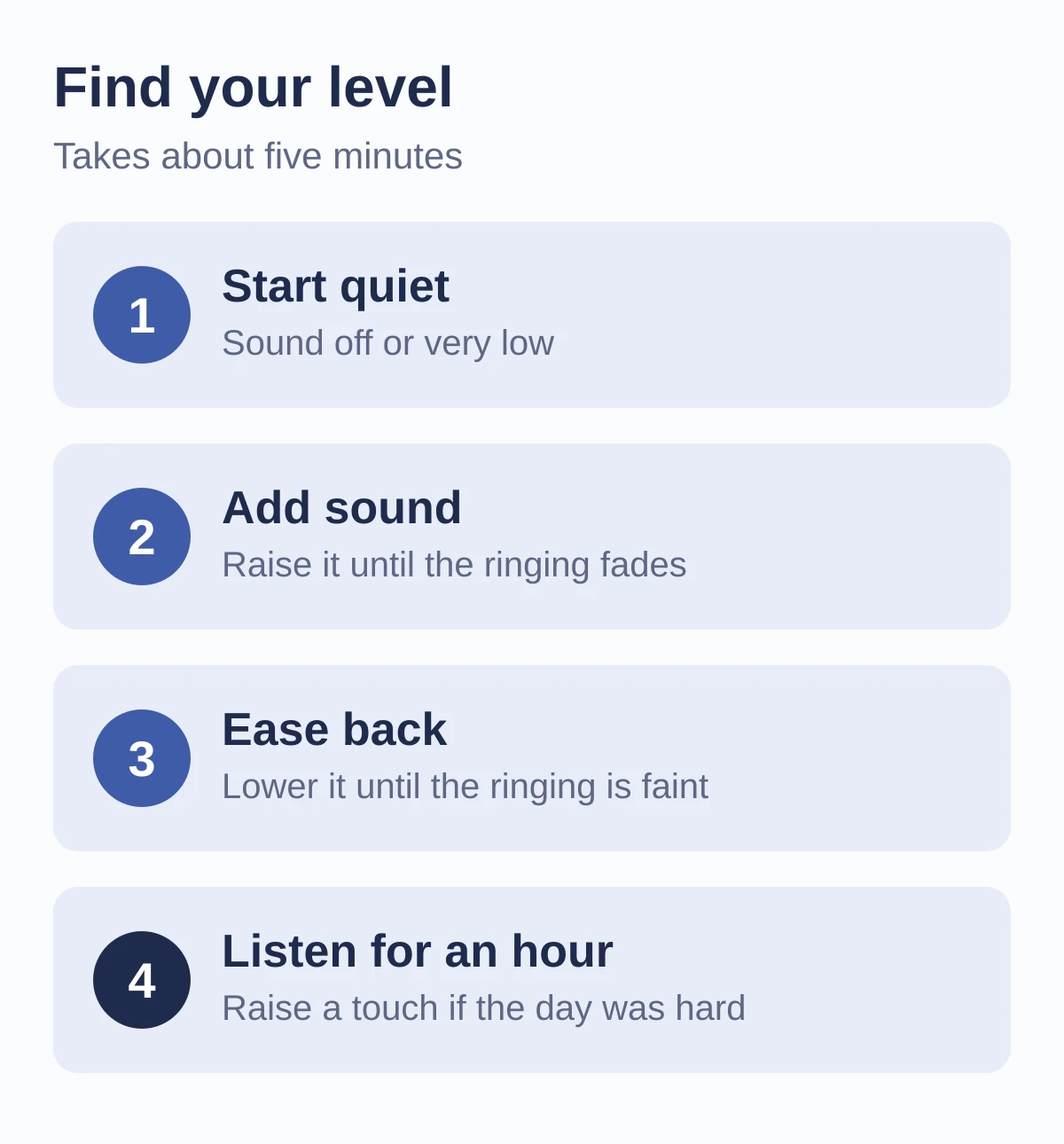
Here is a simple way to set it up. It takes about five minutes.
- Start with the sound off or very low.
- Raise the volume slowly until the ringing starts to fade.
- Lower it a little, until you can still hear the ringing faintly.
- Leave it there for an hour and see how it feels.
If an hour feels easy, you have found your blend. If you are tired or the day was hard, raise it a touch. Harvard Health says an audiologist can help you pick sounds and levels, which is worth asking about.
Where can you use it?
Sound sources are everywhere. The NIDCD lists tabletop and phone sound generators, often used for relaxation or sleep. It also mentions wearable sound generators, which fit in the ear like hearing aids, and hearing aids themselves. They make outside sound louder, which can make the ringing less noticeable.
At night, Tinnitus UK says leaving sound on at a low volume can be a soothing distraction. A bedside speaker is gentler on your ears than earbuds. Our guide to how to sleep with tinnitus covers the bedroom side in more detail.
During the day, try soft sound while you cook, read or rest. Quiet moments are when the ringing is loudest, so they are the best time for it.
How Synra can help with masking
Masking works best when the sound is easy to live with, and that is how we shaped Synra. Pick from brown, pink, green and white noise, or rain and flowing water, all in the Tinnitus Relief collection. Slide the loudness to sit just under your ringing, and set the frequency intensity to Off, Low, Normal or High until it feels right. Choose a 10 to 60 minute timer that fades out softly, and let it play with the screen off. Backdrop Mode tucks the sound under a podcast or your music. The aim is a quieter evening, with a ringing you notice less. Our free 1-minute tinnitus quiz points you to the sounds worth trying first.
When to see a doctor
Please book a visit with your doctor if you notice any of these:
- a beat that keeps time with your pulse (the NHS asks for an urgent GP appointment)
- a sudden start, or sudden hearing loss
- ringing in one ear only
- dizziness, ear pain or discharge
- tinnitus after a head injury
- trouble sleeping, concentrating or staying calm because of the noise
The NHS says to get emergency help if tinnitus comes with sudden hearing loss, facial weakness or vertigo. If you also feel you are hearing less, a hearing test is a sensible next step.
A simple plan for tonight
- After dinner, press play on one soft noise in the player above.
- Raise it until the ringing fades, then lower it a little.
- Try a second sound for two minutes and keep the one that feels kinder.
- At bedtime, set a 30-minute timer and let it fade as you drift off.
- Tomorrow, use the same sound for an hour while you read or rest.
Browse all our tinnitus guides for more ideas.
Common questions
What is tinnitus masking?
Tinnitus masking means playing an outside sound so the ringing is less noticeable. Harvard Health describes it as using external noise to change how you notice or react to tinnitus. Common sounds are white noise, nature sounds, a fan or a radio.
Does masking make tinnitus go away?
Masking does not remove the ringing itself. It gives your ears and brain another sound to listen to, so the ringing stands out less. Many people find that is enough to relax, work or fall asleep more easily.
What is the best sound for tinnitus masking?
There is no single best sound. White, pink and brown noise, rain, flowing water and fans are common choices, and the American Tinnitus Association offers a library of such sounds. A small study found noise close to the pitch of the ringing covered it at a lower volume, so match the sound to your ringing and then trust your own ears.
How loud should a tinnitus masker be?
Tinnitus UK suggests a level a little quieter than your tinnitus for most of the time. A louder sound can give quick relief when you need it. Keep any level comfortable for your ears.
Can I use a masker at night?
Yes. The NHS advises against total silence, and Tinnitus UK says a low sound at night can be a soothing distraction. A timer that fades out is handy if you only need help falling asleep.
Sources (6)
More tinnitus guides
Which sounds suit your tinnitus? Take the free 1-minute quiz.
Free tinnitus quiz →Tinnitus quiz →