White Noise for Tinnitus: How to Use It Gently
White noise can make tinnitus less noticeable by filling the silence. Learn how it works, how loud to keep it, and when pink or brown noise may suit you better.
By Synra Editorial Team · Updated · 6 min read
You turn out the light and the room settles. Then a thin, high note rises above the quiet. You are not imagining it, and you are far from alone.
White noise can help tinnitus feel less noticeable, because it gives your ears a soft, even sound to listen to instead of silence. The NHS says to avoid total silence. Soft sound may distract you from the ringing. White noise is one of the easiest sounds to start with.
Tinnitus masker
Sound is made on your device. Nothing to install.
Start quiet. Raise the level until the ringing just starts to blend in (the “mixing point”), not until it disappears. Keep the volume comfortable, especially with headphones.
What is white noise, and why try it for tinnitus?
White noise is a gentle rushing sound. Tinnitus UK compares it to a radio tuned off-station: static. It is equally strong at every pitch, which is why it sounds bright and even.
The idea is simple. In a silent room, the ringing is the only thing there. Add a soft sound and the ringing has company. The American Tinnitus Association puts it this way: the brain can only focus on one thing at a time, so sound can give immediate relief.
The NIDCD lists three ways sound may help. It may mask the ringing, help you grow used to it, or distract you. White noise can do all three jobs.
Does white noise suit every kind of ringing?
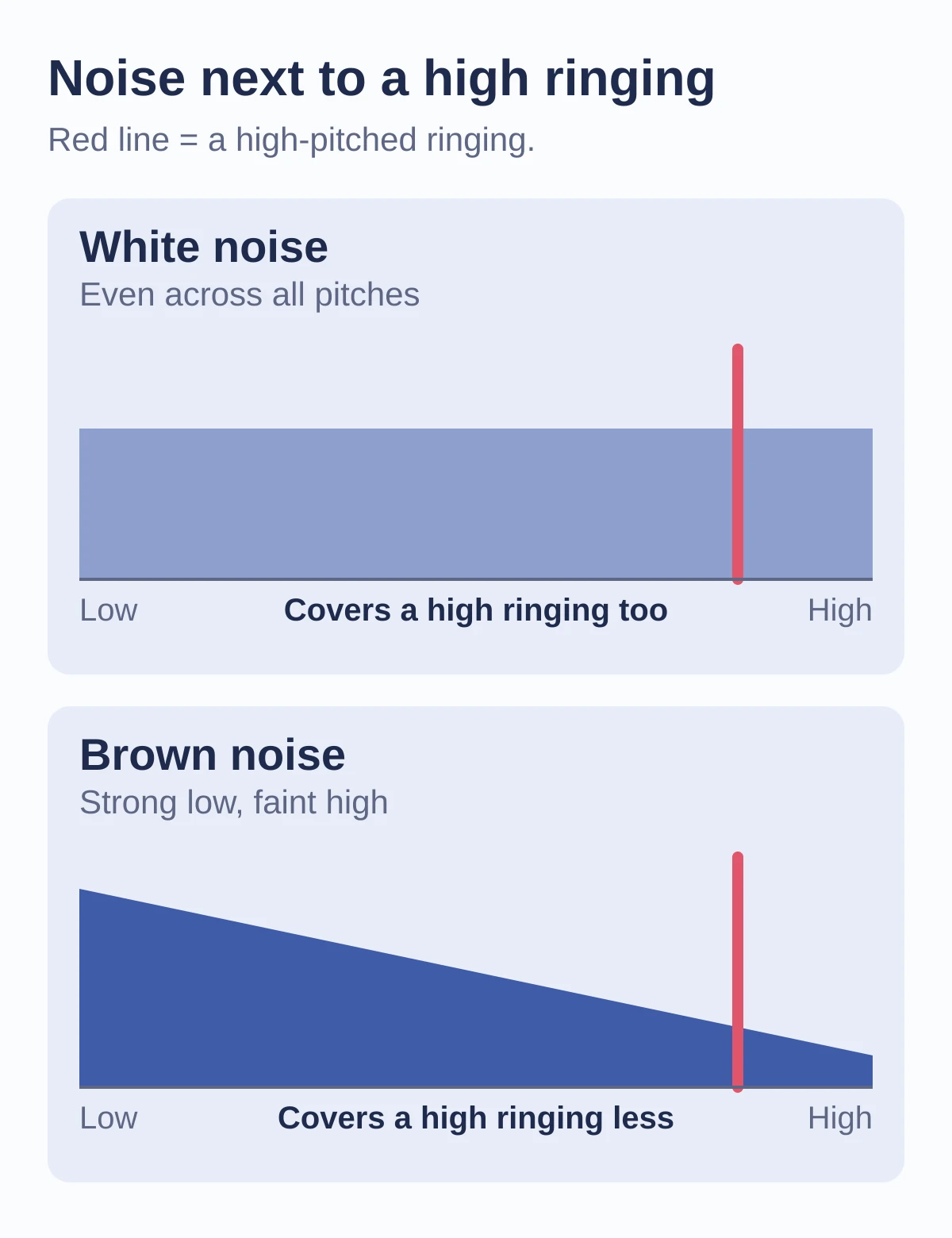
Not always, and that is fine. White noise is strong at high pitches, so it is a natural partner for a high hiss or whistle. A deep hum may sit more comfortably beside a deeper sound.
A small lab study points the same way. Fournier and colleagues tested 68 people with tinnitus. They used broadband noise and narrower bands of noise. Noise centred on the pitch of the ringing, or on the area of hearing loss, covered the ringing at a lower level than noise placed elsewhere. Broadband noise needed a higher level than those matched sounds.
That is a lab test, and it did not use white noise from an app. Still, it gives a helpful rule. The best sound is one that sits close to your own ringing.
How loud should white noise be?
Quieter than you may think. Tinnitus UK says that to help you grow used to the ringing, sound is best used at a level a little quieter than your tinnitus for most of the time.
Loud sound has a place too. It may give short-term relief on a hard day. But Tinnitus UK notes it does not encourage long-term habituation, and the ringing can seem louder once it stops.
So here is an easy rule:
- Everyday: a little under the ringing, so you can still hear it faintly.
- Hard moments: a bit louder for a short while.
- Always: comfortable. If it feels loud, turn it down.
Where can you get white noise?
You do not need special equipment. The NIDCD mentions tabletop and phone sound generators, and says you may also use a radio or a household fan. Here is how the common choices compare.
| Source | Good for | Worth knowing |
|---|---|---|
| Household fan | A free start | One fixed sound, and you cannot turn it down much |
| Bedside sound machine | The bedroom | Choice of sounds at a touch, with a volume dial |
| Phone app | Anywhere | Timers, many sounds, and it comes with you |
| Wearable sound generator | All day | Should be fitted by a tinnitus specialist, says Tinnitus UK |
The player on this page lets you hear white, pink and brown noise side by side. Our free online tinnitus masker does the same on any device.
Can you use white noise at night?
Many people do. Tinnitus UK says relaxing sound can help if you struggle to fall asleep. Left on at a low volume, it can also help if you wake in the night or notice the ringing in the morning.
A speaker on the bedside table is gentler than earbuds in bed. A pillow speaker keeps the sound private if you share a room. Our guide on how to sleep with tinnitus covers the whole bedtime routine.
How long should you give it?
Give each sound a few evenings, not a few minutes. Getting used to a sound takes a little time, so a few evenings gives you a fairer picture.
Keep a small note on your phone. Write the sound, the level and how the evening felt. After a week you will see which sound you reach for. Tinnitus UK describes sound therapy as free or inexpensive and safe to use, so there is little to lose by experimenting.
What if white noise is too sharp?
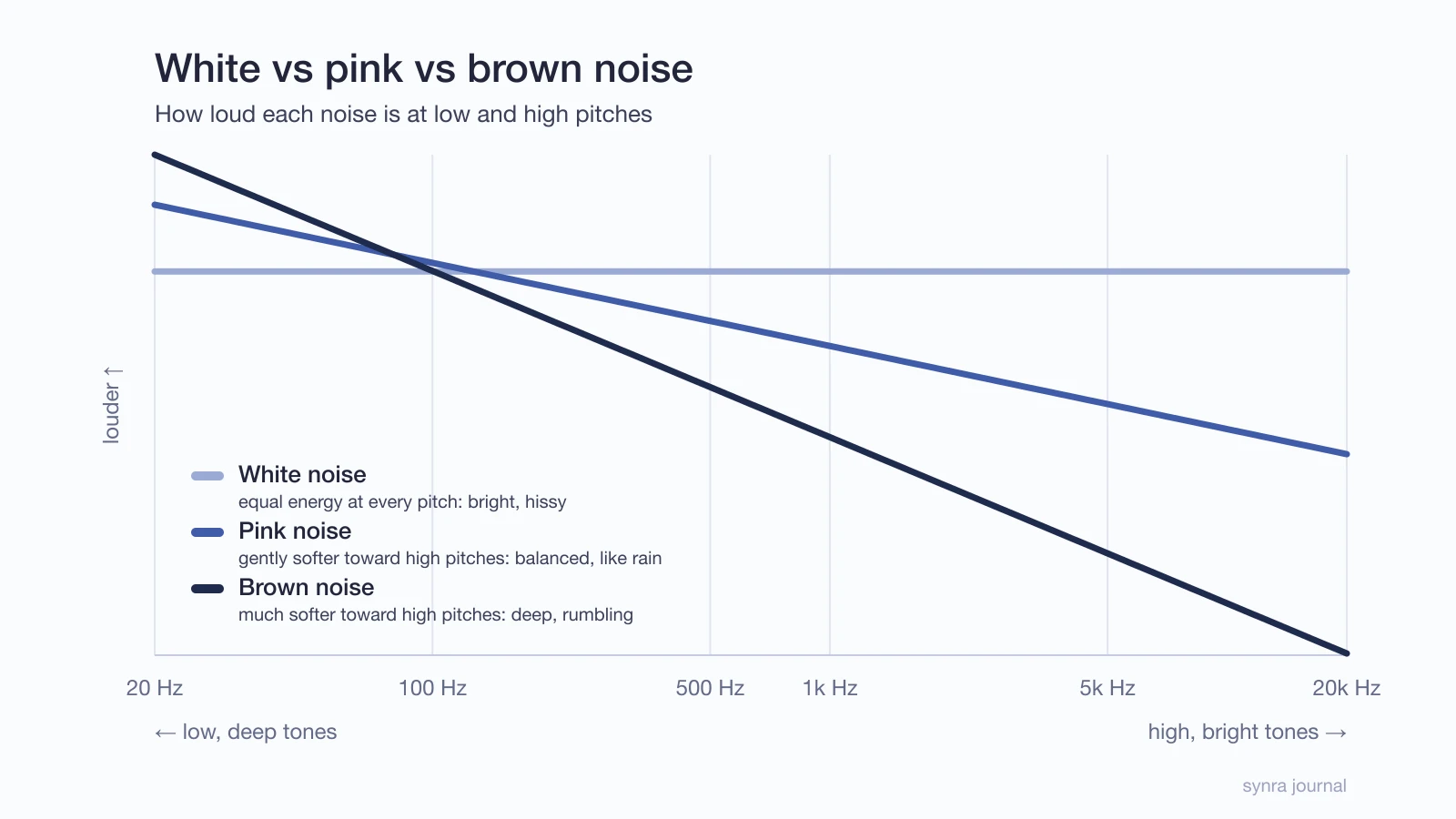
Some people find white noise too bright. That is common, and it is a good reason to try another sound. Pink noise is softer at high pitches. Brown noise is deeper and rounder. The ATA library includes white static, pink noise and brown sound, so you can compare them.
Rain and flowing water are other gentle choices. Our guide to tinnitus masking has a table that matches common ringing sounds to a starting sound. If you are not sure how to describe yours, read what tinnitus sounds like.
How Synra can help with white noise
Finding the noise that sits beside your ringing is what Synra is for. The Tinnitus Relief collection holds white, pink, brown and green noise, with rain and flowing water for softer evenings. One slider sets the loudness just under your ringing. Frequency intensity (Off, Low, Normal or High) shapes how bright the sound feels. A fading timer of 10 to 60 minutes lets you drift off, the sound carries on with the screen off, and Backdrop Mode tucks it beneath a podcast or music. You end up with a calmer room and a ringing you notice less. Our free 1-minute tinnitus quiz points you to the sounds worth trying first.
When to see a doctor
Tinnitus is worth a check-up, and some signs mean you should not wait:
- a whooshing that beats in time with your heart (the NHS asks for an urgent GP appointment)
- ringing that began suddenly, or came with sudden hearing loss
- ringing in only one ear
- dizziness, ear pain or fluid from the ear
- ringing after a knock to the head
- worry or poor sleep that the noise keeps causing
The NIDCD advises starting with your primary care doctor, who can look for causes such as earwax. The 2014 AAO-HNSF guideline says clinicians may offer sound therapy to people with persistent, bothersome tinnitus, so it is fair to ask about it at your visit.
A simple plan for tonight
- Press play on white noise in the player above.
- Raise it until the ringing fades, then lower it a little.
- Switch to pink or brown noise for two minutes. Keep whichever feels kinder.
- At bedtime, set a 30-minute timer and place the speaker beside the bed.
- Tomorrow, try the same sound while you read or rest.
Browse all our tinnitus guides for more ideas.
Common questions
Is white noise good for tinnitus?
Many people find white noise makes the ringing less noticeable, especially in a quiet room. The NHS advises against total silence, and the NIDCD says sound may mask tinnitus, help you grow used to it, or distract you. Results differ from person to person, so try it for a few evenings.
How loud should white noise be for tinnitus?
Tinnitus UK suggests a level a little quieter than your tinnitus for most of the time. A louder sound can give short-term relief, but it does not help you grow used to the ringing in the long run. Always keep it comfortable for your ears.
Can I sleep with white noise on if I have tinnitus?
Yes. Tinnitus UK says relaxing sound can help if you struggle to fall asleep, and a low sound left on can distract you if you wake in the night. A bedside speaker or a pillow speaker is a gentle way to play it.
What is the difference between white, pink and brown noise?
White noise is equally strong at every pitch, so it sounds bright, like radio static. Pink noise is softer at high pitches and brown noise is deeper still. The American Tinnitus Association offers all three in its masking sound library.
Is a fan as good as a white noise machine?
The NIDCD lists a household fan and a radio among sound generators you can use. If it makes the ringing less noticeable and you like the sound, it works well. A machine or app adds choice of sound and a timer.
Sources (6)
- Tinnitus UK (British Tinnitus Association): Sound therapy
- NIDCD (NIH): Tinnitus
- NHS: Tinnitus
- American Tinnitus Association: Sound therapy
- Fournier P et al. A New Method for Assessing Masking and Residual Inhibition of Tinnitus. Trends in Hearing, 2018
- AAO-HNSF: Clinical practice guideline on tinnitus, press release fact sheet
More tinnitus guides
Which sounds suit your tinnitus? Take the free 1-minute quiz.
Free tinnitus quiz →Tinnitus quiz →