Green Noise for Tinnitus: A Soft, Nature-Like Sound
Green noise is a soft, mid-range sound like a stream or the sea. Find out what it is, why it can ease the ringing, and how to test it for yourself.
By Synra Editorial Team · Updated · 5 min read
You are lying in the dark and the ringing is the loudest thing in the room. White noise is too sharp. Brown is too heavy. You want something that sounds like a stream.
Green noise is a soft, steady sound built around the middle pitches, and it may make tinnitus less noticeable by filling the silence with something gentle. The NHS says not to sit in total silence, because soft sounds may distract you from the tinnitus. Green noise is one easy choice.
Tinnitus masker
Sound is made on your device. Nothing to install.
Start quiet. Raise the level until the ringing just starts to blend in (the “mixing point”), not until it disappears. Keep the volume comfortable, especially with headphones.
What is green noise?
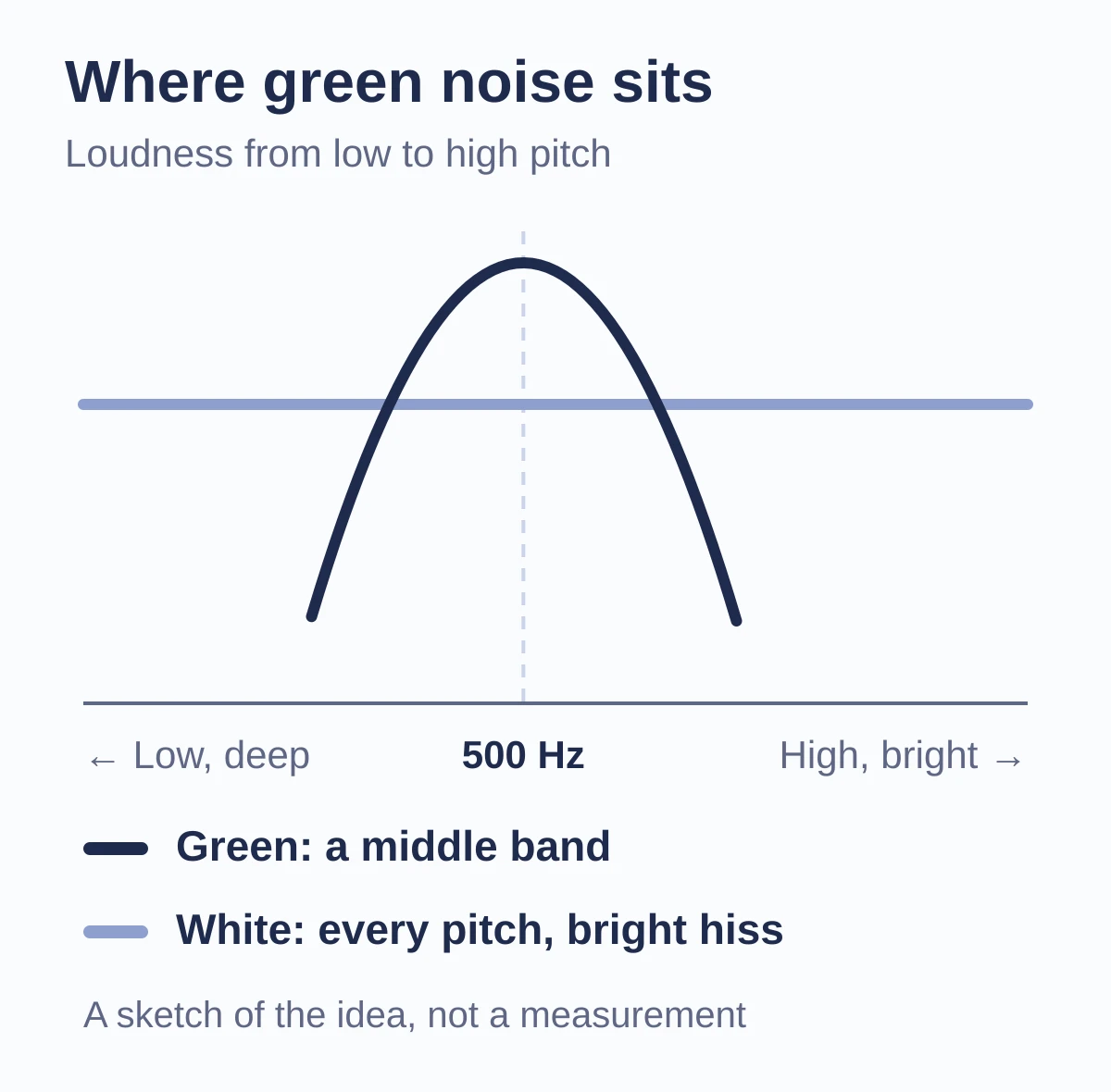
Green noise is a newer name, and it is not strictly defined. The Sleep Foundation calls it a variant of white noise that lifts the frequencies in the middle of what we hear. It says these mid-range tones mimic sounds in nature, like the ocean or a stream.
White noise keeps the high tones, which gives it a hissing edge. Green noise trims them. Some sites, such as Oura, put the centre near 500 Hz and say it often comes from recordings of nature, like waves or gentle rain.
Because the name is loose, two green noise tracks can sound a little different. That is fine. You are choosing a sound by ear, not by label.
Why might a nature-like sound help with tinnitus?
In a silent room the ringing has the stage to itself. A steady, soft sound shares it.
The American Tinnitus Association explains that the brain can only attend to one thing at a time, which is why a pleasant sound can ease intrusion. Its free masking library offers 60-minute recordings of rivers, fountains, a waterfall, a stream, rain and wind.
Tinnitus UK says many people find that wind in the trees or waves breaking on the shore make their tinnitus less noticeable. It adds that the best sound is usually pleasant and easy to ignore, which describes green noise well.
What does the research say?
Studies of green noise by name are rare, so we look at the closest evidence: nature sounds. Durai and colleagues worked with 18 adults whose average age was about 62. Each chose a nature sound, such as water or rain, birds or cicadas. A recording matched to their own tinnitus slowly faded into that sound.
They listened for 3 months. Scores on the Tinnitus Functional Index fell, including the parts that measure how intrusive the ringing feels and how hard it is to concentrate. People also rated their tinnitus as less strong and easier to ignore.
This was a small study with no comparison group, and the sound was not green noise itself. In interviews, people said their tinnitus did not get weaker, but they described its pitch and evenness as changing. Take it as a hopeful sign for nature-like sound, then test it on your own ears.
Where should you start?
Your ringing and your own taste should decide. Use the table as a first guess.
| What you notice | Try first | Why |
|---|---|---|
| White noise sounds harsh or tiring | Green noise or pink noise | Softer, with less hiss |
| You like streams, waves or rain | Green noise or rain | Close to sounds you already enjoy |
| A deep hum or roar | Brown noise | A low sound sits beside a low ringing |
| A thin, high whistle | White noise | Brighter sounds sit closer to a high pitch |
Struggling to put your ringing into words? Browse what tinnitus can sound like. The player above has brown, pink and white. Pink is the nearest to green, so press play and listen for that soft, even hush.
Want to compare the others? Read about white noise, pink noise and brown noise for tinnitus. You can also use our online tinnitus masker without installing anything.
How loud should green noise be?
Softer than you think. Tinnitus UK suggests a level a little quieter than your tinnitus for most of the day. Drowning the ringing out completely can make it seem louder once the sound stops.
A quick way to set it:
- Press play with the volume almost off.
- Nudge it up until the ringing and the sound seem to share the room.
- If you can no longer hear the ringing at all, lower it one notch.
Is green noise a good bedtime sound?
A stream-like hush suits the dark. Tinnitus UK says a relaxing sound can help when sleep will not come. If you wake at 3 a.m., a quiet sound left running gives your mind somewhere softer to rest.
A speaker on the bedside table is the simplest set-up. A pillow speaker keeps a partner out of it, says Tinnitus UK. A fading timer lets the sound go quiet as you doze off. For the rest of your evening routine, see our guide on how to sleep with tinnitus.
How do you give a new sound a fair try?
Your ears need a little time with any new sound. Give it three nights before you decide.
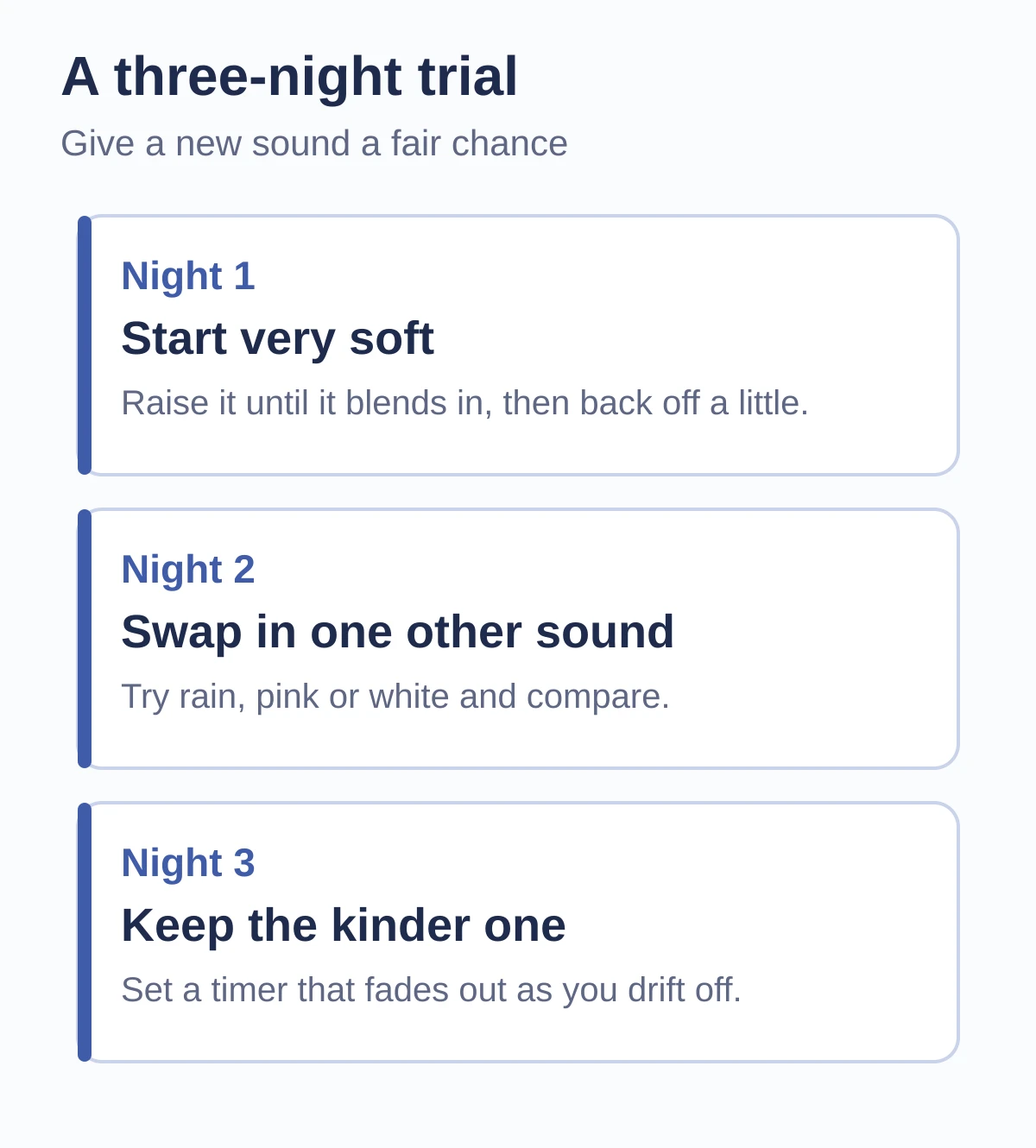
Tinnitus UK encourages trying out different sounds to see what works for you. For ideas on pairing a sound with your ringing, read about tinnitus masking.
How Synra can help with green noise
We built Synra for the nights when you want a stream and your speaker only offers static. The Tinnitus Relief collection has green noise right next to brown, pink and white, with rain and flowing water for variety. A loudness slider lets you tuck the sound just under the ringing, and frequency intensity (Off, Low, Normal or High) shifts it softer or brighter. Choose a timer from 10 to 60 minutes and the sound fades as you drift off, even with the screen off. Backdrop Mode lets it play quietly under a podcast or music. The result is a calmer room and a ringing that stands out less. The free 1-minute tinnitus quiz will point you to sounds worth trying first. Why not take it tonight?
When to see a doctor
Book a visit with your doctor if any of these sound like you:
- a beat or whoosh that keeps time with your pulse (the NHS advises an urgent GP appointment)
- tinnitus that came on suddenly, or alongside sudden hearing loss
- ringing in one ear only
- dizziness, ear pain or discharge
- ringing that is getting worse
- low mood, poor sleep or trouble concentrating because of the noise
Until then, a soft sound can make the waiting easier.
A simple plan for tonight
- Before bed, play the pink noise above at a whisper and listen for the soft hush.
- Open a green noise track in your sound app and switch between the two.
- Keep the one that feels kinder, and set it a little under the ringing.
- Choose a 30-minute fading timer and put the speaker within reach.
- In the morning, write one line: which sound, and how the night went.
More reading is in our full set of tinnitus guides.
Common questions
What is green noise?
Green noise is a soft sound built around the middle pitches. The Sleep Foundation calls it a variant of white noise that lifts mid-range frequencies, which it says mimic sounds in nature, like the ocean or a stream. The name is new and not strictly defined, so different apps make it slightly differently.
Is green noise good for tinnitus?
Many people find soft, nature-like sound pleasant, and Tinnitus UK says sounds such as wind in the trees or waves on the shore make tinnitus less noticeable for many. Studies of green noise by name are rare, so the best test is how it feels to you over a few nights.
Is green noise the same as pink noise?
No, but they feel close. Both sound softer than white noise. The Sleep Foundation says pink noise sits around the mid and lower pitches and sounds like falling rain, while green noise focuses on the middle. Try both and keep the one you like.
How loud should green noise be for tinnitus?
Tinnitus UK advises keeping it just under the level of your ringing for most of the day. Begin very soft, raise it until it blends in, then ease back.
Can I sleep with green noise on?
Yes. Tinnitus UK says a relaxing sound can help when sleep is slow to come, and a quiet one left running can soothe you if you wake in the night. A bedside speaker and a fading timer make a gentle start.
Sources (6)
- Sleep Foundation: What is green noise and how can it help you sleep?
- Tinnitus UK (British Tinnitus Association): Sound therapy
- NHS: Tinnitus
- American Tinnitus Association: Sound therapy
- Durai M et al. Behavioral Outcomes and Neural Network Modeling of a Novel, Putative, Recategorization Sound Therapy. Brain Sciences, 2021
- Oura: What is green noise and can it help you sleep better?
More tinnitus guides
Which sounds suit your tinnitus? Take the free 1-minute quiz.
Free tinnitus quiz →Tinnitus quiz →